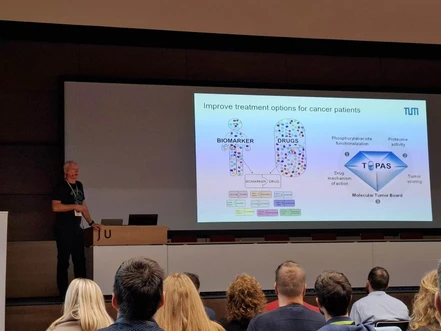
13. Česká konference hmotnostní spektrometrie 2025 a 11. Neformální proteomické setkání - Den 1
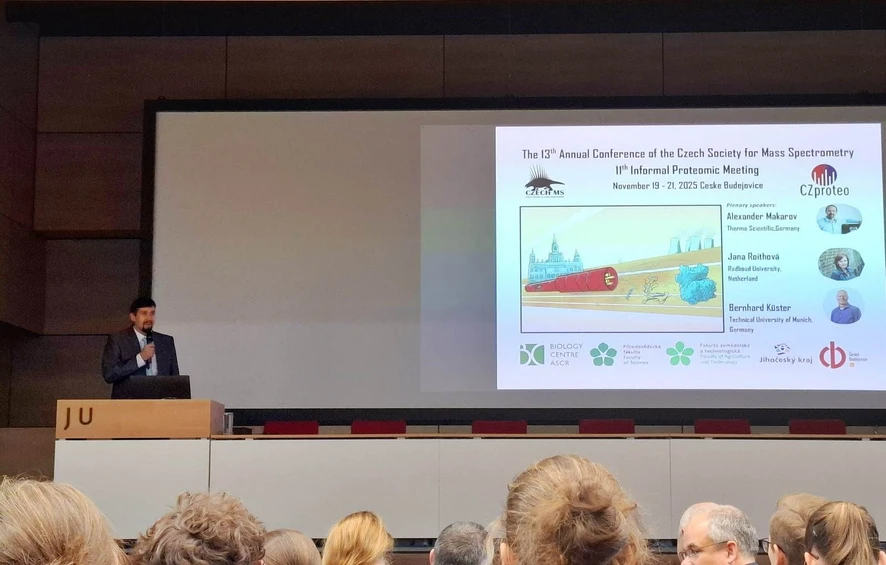
ČSHS: 13. Česká konference hmotnostní spektrometrie 2025 a 11. Neformální proteomické setkání - Den 1
První den 13. České konference hmotnostní spektrometrie a 11. Neformálního proteomického setkání v Českých Budějovicích se nesl ve znamení příjezdů, registrací a opětovných setkání vědecké komunity. Zahájení konference a úvodního slova se ujal Zdeněk Kukačka, který představil program letošního ročníku, zdůraznil propojení hmotnostní spektrometrie s proteomikou a poděkoval partnerům i organizátorům za podporu celé akce.
Hlavním vědeckým vrcholem úvodního dne byla plenární přednáška Prof. Alexandra Makarova (Thermo Fisher Scientific) věnovaná minulosti, současnosti a budoucnosti hmotnostní spektrometrie Orbitrap. Profesor Makarov připomněl dvacetiletý vývoj Orbitrap analyzátorů od prvních komerčních přístrojů až po dnešní komplexní platformy kombinující kvantitativní analýzu, nové fragmentační techniky, zobrazování, iontovou mobilitu či extrémně vysoký hmotnostní rozsah. Zvláštní pozornost věnoval novému Orbitrap Astral hmotnostnímu spektrometru, který spojuje principy Orbitrapu a time-of-flight detekce a posouvá citlivost zejména v oblastech single-cell proteomiky. V závěru podtrhl, že rychlý rozvoj přístrojové techniky a datové analýzy drží hmotnostní spektrometrii na špici mezi analytickými technologiemi.
Odpolední odborný program pokračoval prvními dvěma sekcemi. V Sekci I zazněly příspěvky zaměřené na hmotnostně spektrometrickou infrastrukturu pro výzkum lidského exposomu v rámci českého uzlu EIRENE, optimalizaci mikroflow LC-MS metodiky pomocí designu experimentů pro proteomické aplikace a na novou HILIC-FLD-MS strategii umožňující současné mapování peptidů a uvolněných N-glykanů pro kontrolu kvality bioléčiv. Po přestávce následovala sponzorská přednáška Phenomenex zaměřená na využití core-shell technologií v nano- a micro-flow LC proteomice. V Sekci II se program přesunul do oblasti strukturní hmotnostní spektrometrie: byly představeny studie interakcí G-quadruplexů s ligandy pomocí nativní MS a iontové mobility, strukturální analýza cyanobakteriální primázo-helikázy CyRepA2 kombinací nativní MS a H/D výměny, detailní rozklad hypermodifikovaného RiPP nostatinu A pomocí IRMPD, i oligomerizací zprostředkovaná regulace GGPPS ve vztahu k nádorovým onemocněním.
Večerní blok patřil sponzorské přednášce od Geneticy věnované proteomickému přístupu a první sérii krátkých „flash talks“. Mladí vědci a doktorandi představili nové LC-MS metody pro kvantifikaci oxokyselin v lidském metabolomu, instrumentální analýzu lidského pachu, nový rDUVLAESCI-MS/MSI přístup pro přímé zobrazování molekul na biologických površích, studium fenolických látek ve vinných výliscích, iniciativu MERLIN pro tvorbu otevřených MSⁿ knihoven a rozsáhlou timsTOF MS/MS knihovnu pro zlepšení anotace metabolitů v necílené metabolomice. První den pak byl završen večerním rautem s živou hudbou.
Program
Středa 19. listopadu 2025
10:00 - 18:00 Registrace
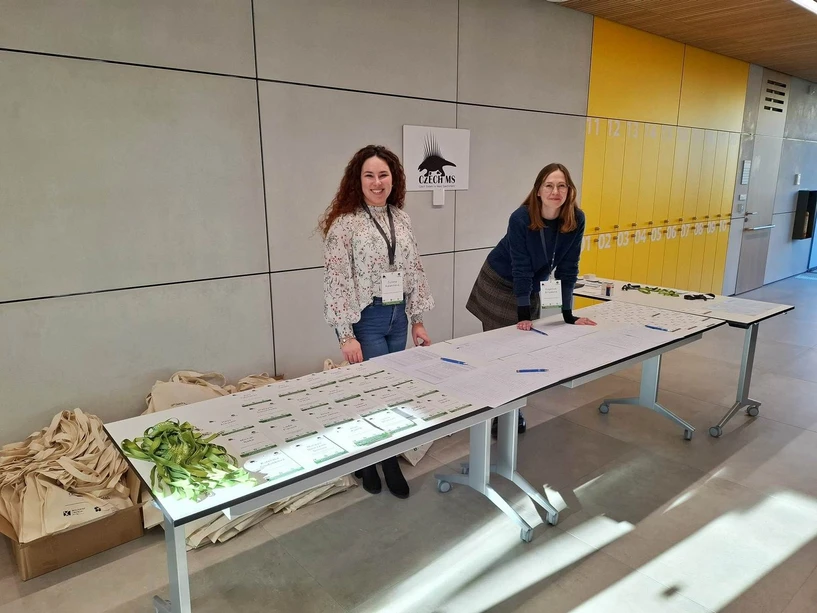 ČSHS: 13. Česká konference hmotnostní spektrometrie 2025 a 11. Neformální proteomické setkání - Den 1 - Registrace
13:45 - 14:00 Zahájení konference
ČSHS: 13. Česká konference hmotnostní spektrometrie 2025 a 11. Neformální proteomické setkání - Den 1 - Zahájení (Zdeněk Kukačka)
14:00 - 15:00 Plenární přednáška I: Past, present and future of Orbitrap Mass Spectrometry
- Prof. Alexander Makarov (Thermo Fisher Scientific)
Since its commercial debut two decades ago, the utility of the Orbitrap™ analyzer has been continuously extended by additional capabilities such as quantitative analysis, new fragmentation methods, diverse vacuum and ambient ion sources, imaging, ion mobility and unprecedented extension of mass range. These enhancements evolved over multiple major families of Orbitrap-based instruments that became a real workhorse of many applications.
As the latest example of such evolution, the asymmetric track lossless (Astral™) analyzer is combining together Orbitrap and time-of-flight features to dramatically improve sensitivity and throughput of proteomic analysis. Performance and operation of this newest analyzer are described in detail, especially for single-cell proteomic experiments.
An overview of main trends in evolution of mass spectrometry instrumentation demonstrates ample reserves in further expansion of analytical capabilities, mainly via combining advanced analyzers with improved ion scheduling and utilization.
The talk concludes with the belief that the latest rapid progress in all aspects of instrumentation and analysis will enable mass spectrometry to remain competitive against alternative technologies and to rise to the challenge of unprecedented throughput of very deep analyses of very complex samples.
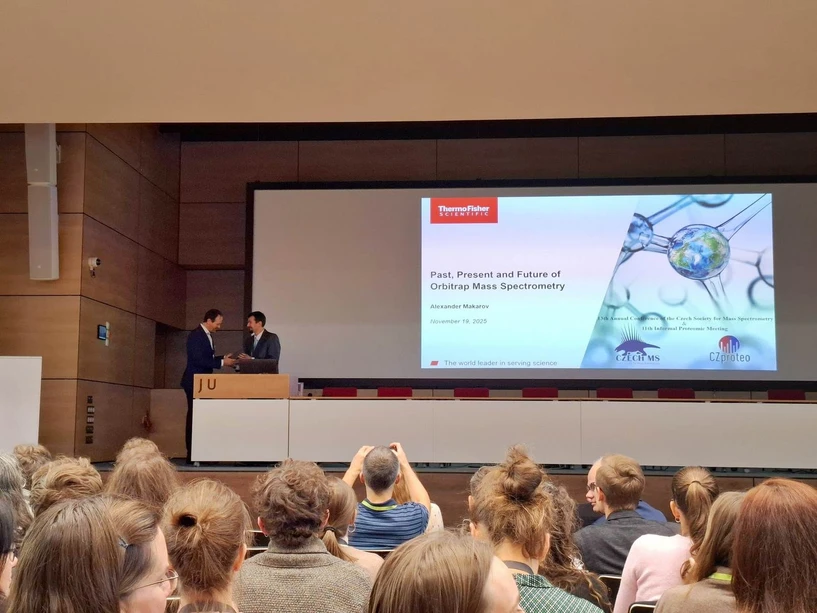 ČSHS: 13. Česká konference hmotnostní spektrometrie 2025 a 11. Neformální proteomické setkání - Den 1 (Past, present and future of Orbitrap Mass Spectrometry, Prof. Alexander Makarov, Thermo Fisher Scientific)
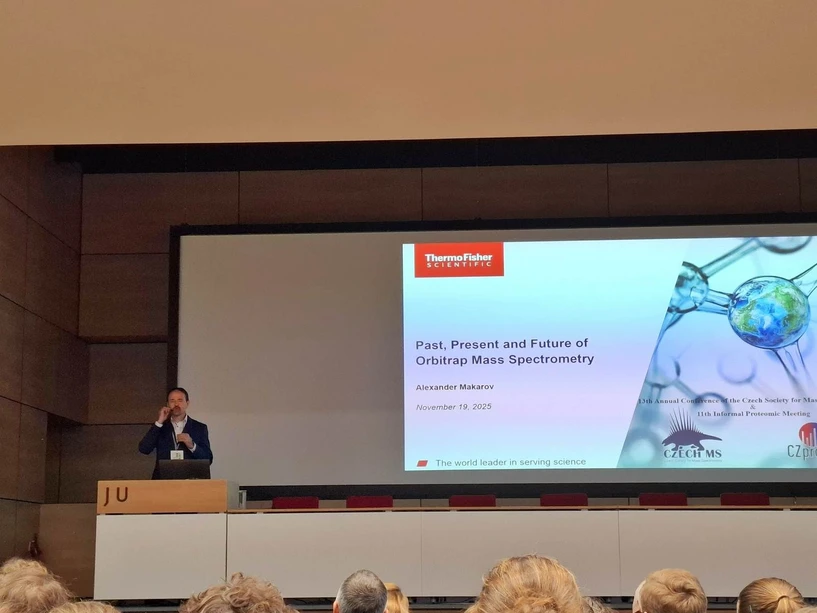 ČSHS: 13. Česká konference hmotnostní spektrometrie 2025 a 11. Neformální proteomické setkání - Den 1 (Past, present and future of Orbitrap Mass Spectrometry, Prof. Alexander Makarov, Thermo Fisher Scientific)
15:00 - 16:00 Sekce I (Chairperson: Michael Volný)
15:00 - 15:20 WeO-01: Towards MS-guided Precision Environmental Health: the Czech node of the European Research Infrastructure for Human Exposome Research
- Elliott James Price
Understanding the molecular determinants of health and disease is essential for advancing precision prevention and treatment. Yet, the current availability of high-throughput assays for quantifying broad panels of clinically relevant proteins, metabolites, and environmental chemicals remains limited. The European Infrastructure for Human Exposome Research (EIRENE) is addressing this challenge by building a harmonized network of laboratories, population cohorts, environmental studies, and databases to elucidate how environmental exposures contribute to chronic disease.
This presentation introduces the mass spectrometry (MS) resources developed within the Czech node of EIRENE (EIRENE-CZ). These resources are designed to enable: (i) population-scale profiling of human exposure to environmental chemicals, (ii) quantitative analysis of clinically relevant protein and metabolite biomarkers, and (iii) high-throughput processing of MS data.
A suite of targeted MS assays has been established for the absolute quantification of biomarkers defined at the intersection of the Hallmarks of Health and Hallmarks of Environmental Insults frameworks. We shall report on applications to clinical research studies, evaluation compared to alternative clinical measurement approaches, and welcome input to prioritise key biomarkers and guide future assay development.
In parallel, LC- and GC-HRMS workflows for population-scale chemical exposure profiling have been implemented, and ongoing applications in cohort studies will be highlighted. We will reflect on current technological limitations and prospects for an international precision environmental health monitoring network.
15:20 - 15:40 WeO-02: Optimization of microflow LC-MS method by design of experiments and its application to proteomics analysis
- Urban Jiří
Due to the reduced radial dilution of analytes, liquid chromatography-mass spectrometry (LC-MS) utilizing narrow columns with an internal diameter of 50 – 75 μm is almost exclusively used in ultra-trace proteomics analysis of limited sample amounts. Micro-flow LC-MS employing columns with an inner diameter of 1 mm is a viable alternative in cases where the sample amount is not limited. It offers robust qualitative and quantitative performance characteristics, simplicity of implementation, and an extensive range of high-quality micro-flow columns. Additionally, micro-column LC analysis is readily applicable to routine clinical applications.
In this work, we have employed the design of experiments protocol to optimize the micro-flow LC-MS method and to investigate the primary factors controlling its sensitivity in bottom-up proteomics analysis.
We divided the optimization process into several consecutive steps planned by Box-Behnken designs. Signal intensity and the number of identified peptides were all used as optimization criteria. In liquid chromatography, we tested the effect of mobile phase flow rate, column temperature, and gradient time. In electrospray coupling, we optimized the position of the capillary, its temperature, voltage, and the flow of sheath, auxiliary, and sweep gases. Finally, we focused on optimizing the ion injection time, automatic gain control target, and Orbitrap analyzer resolution utilizing full MS and MS/MS scans.
During the optimization process, the signal intensity and number of identified peptides increased by a factor of four and two and a half times, respectively. After optimizing with a semi-complex proteomic sample, we analyzed the real-life sample and compared the obtained results with those in the literature.
15:40 - 16:00 WeO-03: Simultaneous mapping of peptides and released N-glycans by HILIC-FLD-MS for quality control of protein biopharmaceuticals
- Starovoit Mykyta
Protein biopharmaceuticals, especially monoclonal antibodies, have revolutionized therapeutic regimes. However, their structural complexity presents analytical challenges. Modifications such as glycosylation and deamidation affect efficacy and immunogenicity, demanding precise monitoring of critical quality attributes (CQAs). Current multi-attribute methods, based on reversed-phase (RP) LC-MS of tryptic peptides, struggle with hydrophilic peptides and show limited resolution of deamidated, isoAsp-containing, and glycosylated peptides. Glycosylation assessment often requires separate workflows with enzymatic release, fluorescent labeling, and HILIC-FLD analysis.
We propose a UHPLC method that combines the mapping of tryptic peptides with released, RapiFluor-MS-labeled N-glycans in a single HILIC-FLD-MS run, utilizing convenient sequential injection of peptide and glycan fractions. The approach separates peptides in the initial part of the chromatogram, followed by glycans in later retention windows, with fluorescence labeling enhancing glycan detection. Coupled with tandem mass spectrometry, this approach provides full protein sequence coverage and superior resolution of isomeric glycoforms, deamidated peptides, and isoAsp residues versus RPLC workflows. Analysis of released, labeled glycans further outperforms glycopeptide separation, both by RPLC and HILIC, in preserving terminal sialic acids that are prone to in-column cleavage at acidic pH and high column temperatures.
This integrated HILIC workflow could simplify biopharmaceutical quality control by enabling the simultaneous monitoring of multiple CQAs, which now require distinct methods, thereby improving efficiency, reliability, and the cost per sample.
16:00 - 16:30 Přestávka na kávu
16:30 - 16:50 Sponzorská přednáška – Phenomenex: Advancing Nano/Micro LC Proteomics with Core-Shell Technology
- Lucia Geis-Asteggiante
16:50 - 18:10 Sekce II (Chairperson: Jana Havlíková)
16:50 - 17:10 WeO-04: G-quadruplex – ligand interaction biophysics explored by native mass spectrometry and trapped ion mobility spectrometry
- Melikov Aleksandr
Guanine-rich nucleic acid sequences are able to form G-quadruplexes (G4), both in vivo and in vitro. Due to their involvement in many important biological processes, such as gene expression and telomere maintenance, G-quadruplexes became a prominent target for anticancer therapy by small G4-binding molecules, or G4 ligands. Mass spectrometry combined with electrospray ionization source (ESI-MS) provides a great tool to relatively quickly asses the in-solution binding properties of G4 ligands, as was determined by previous studies . Coupling ESI-MS with the trapped ion mobility (timsTOF SCP) and the in-house made variable-temperature nano-electrospray source (vt-nESI) allows to obtain a detailed biophysical characterization of G4-ligand interactions.
In native conditions (room temperature), all the tested compounds showed very high affinity for parallel folds (both intra and intermolecular), as well as telomeric variants. For the telomeric hybrid topologies, the displacement of 1 of the 2 ammonium cations initially complexed by the G4 by the ligand suggests a similar binding mode as PhenDC3, that is, intercalation between G-quartets. The melting experiments conducted with the vt-nESI source allowed us to monitor temperature-dependent G4 unfolding, extrapolate binding constants to room temperature, as well as to estimate thermodynamic parameters of ligand binding by van’t Hoff equation fit. In addition, the effect of coordinated cation (ammonium vs potassium) and the annealing of G4 in the temperature-controlled environment was tackled by these techniques for several human telomeric sequence variants. Future work will be devoted to the influence of ligands on protein binding to G-quadruplexes.
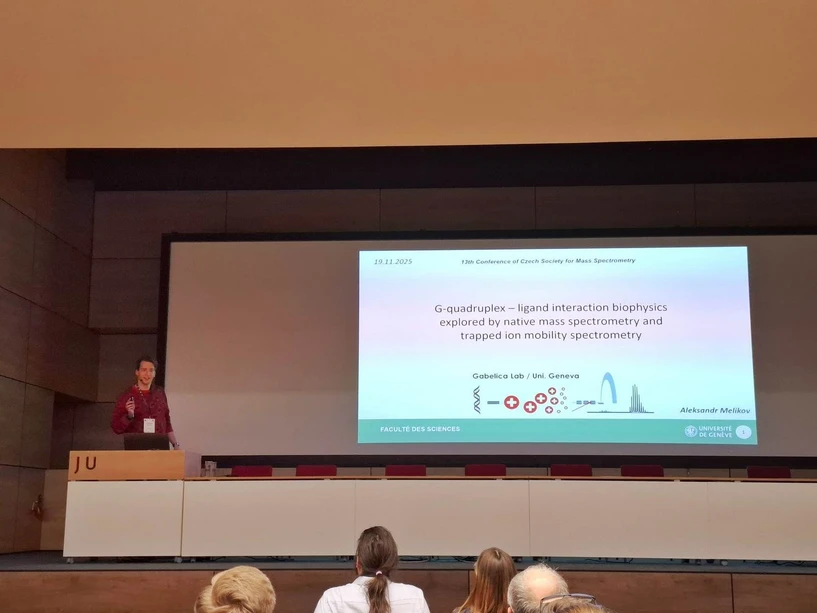 ČSHS: 13. Česká konference hmotnostní spektrometrie 2025 a 11. Neformální proteomické setkání - Den 1 (G-quadruplex – ligand interaction biophysics explored by native mass spectrometry and trapped ion mobility spectrometry, Aleksandr Melikov)
16:50 - 17:10 WeO-05: Insights into CyRepA2 primase-helicase-DNA interactions using structural mass spectrometry
- Smrčka Tomáš
Native mass spectrometry and H/D exchange are well-established structural mass spectrometry methods. Here we show how their combination could provide a complementary information of a dynamic protein-DNA interaction. Specifically, we examined the DNA binding of cyanobacterial primase-helicase CyRepA2.
Using native mass spectrometry, the oligomeric state and binding modes of CyRepA2 was examined in complex with several DNA ligands. With H/D exchange, the sites of DNA-induced structural changes were identified and a primase/helicase domain interface was probed. Furthermore, the role of ATP and AMP-PNP binding was also extensively studied providing insights into the dynamic nature of the enzyme’s function.
Overall, our work proves how the native mass spectrometry data together with the H/D exchange data nicely complement each other and together provide a comprehensive structural and functional insight into a highly dynamic protein complex.
16:50 - 17:10 WeO-06: Breaking the Unbreakable: Structural Elucidation of the Hypermodified RiPP Nostatin A by IRMPD Mass Spectrometry
- Hájek Jan
Ribosomally synthesized and post-translationally modified peptides (RiPPs) represent a diverse and biologically significant class of natural products. However, their extensive post-translational modifications often pose major challenges for structural elucidation. Nostatin A (NosA, ~2.5 kDa) is a highly modified RiPP belonging to the nitrile hydratase–like leader peptide family (proteusins). Its 30-amino-acid core undergoes extensive structural modification, including the formation of nine thiazole/oxazole rings, eight dehydroalanine/dehydrothreonine residues, and an additional unique sactipeptide bridge. These modifications result in an extremely rigid and compact structure that resists conventional ESI ionization and collision-induced dissociation. Furthermore, NMR spectroscopy failed to provide sufficient data for complete structural elucidation. To overcome these limitations, infrared multiphoton dissociation (IRMPD) spectroscopy was employed, enabling controlled fragmentation and the observation of interpretable fragments across the m/z range of 200–2000. Interestingly, NosA predominantly fragmented into stable tripeptidic subunits composed of amino acid–oxa/thiazole–Dha/Dhb motifs, which resisted further cleavage. A novel approach combining empirical formula analysis of these smaller fragments allowed the determination of the complete molecular formula of Nostatin A.
16:50 - 17:10 WeO-07: Unraveling Oligomerization-Mediated Inhibition in GGPPS by Structural Mass Spectrometry
- Portašiková Jasmína
Geranylgeranyl diphosphate synthase (GGPPS) is a trans-prenyltransferase that catalyzes the production of the geranylgeranyl moiety in living organisms. In cells, the geranylgeranyl group can be attached to proteins, such as Rab or Rho proteins, enabling their interaction with membranes. Dysfunction in protein prenylation associated with GGPPS mutations has been proven responsible for the development of multiple myeloma and other malignant transformations. Therefore, GGPPS is a valuable target for anti-cancer drugs.
Oligomeric assemblies of GGPPS vary across organisms. In lower-level species, GGPPS assembles in a dimeric organization, whereas in higher-level species, such as humans, GGPPS forms a hexamer composed of three dimers. The inter-dimeric interaction is facilitated by hydrophobic interactions and hydrogen bonds.
In the past, the R235C mutation was discovered in human GGPPS of multiple myeloma patients. This mutation is localized to the active site lid region at the inter-dimeric interface. Using native MS experiments, we uncovered lower stability of the hexameric organization due to destabilized inter-dimeric interactions in the R235C mutant. Subsequently, we performed HDX-MS experiments, which showed reduced lid dynamics in the wild-type compared to the R235C mutant, thereby blocking the pathway for product release. These results indicate that faster product release in the R235C mutant leads to higher catalytic activity of the mutant protein due to decreased product inhibition. Additionally, experiments on the dimeric Y246D mutant showed even faster product release than the R235C mutant. Therefore, we conclude that these functional alterations are directly influenced by the oligomeric assembly of the protein.
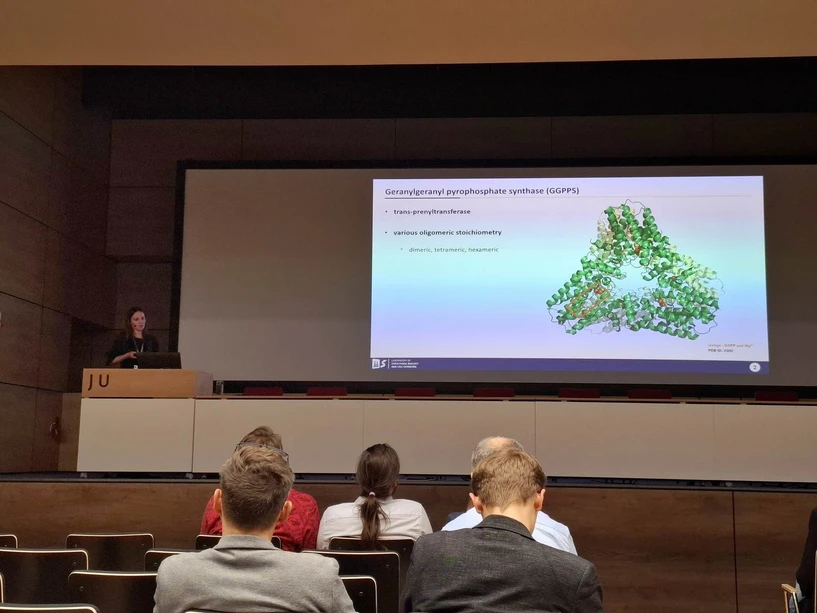 ČSHS: 13. Česká konference hmotnostní spektrometrie 2025 a 11. Neformální proteomické setkání - Den 1 (Unraveling Oligomerization-Mediated Inhibition in GGPPS by Structural Mass Spectrometry, Jasmína Portašiková)
18:10 - 18:30 Sponzorská přednáška – Genetica: A Multi-Approach Exploration of the Proteome: Integrating Three Platforms
18:30 - 19:00 Flash Talks I (Chairperson: Zdeněk Spáčil)
Quantification of Oxoacids of the Human Metabolome using Liquid Chromatography-Mass Spectrometry (WeS-01)
- Hebesberger Philipp
Detection and quantification of metabolites serves to understand how various organisms function, as it can unveil new metabolic pathways and provide insight into their regulation. Liquid chromatography with mass detection is one of the leading analytical techniques in metabolomics. However, LC-MS detection is limited when analytes have poor stability or poor ionization efficiency. To overcome these hurdles, analytes can be derivatized to enhance sensitivity by conferring a permanent charge and generating a stable derivative [1]. Quaternary Aminooxy (QAO) reagents provide an opportunity to assess a range of metabolites with oxo groups by generating stable, positively charged oxime derivatives at acidic pH [2].
To explore the potential of QAO reagents, a method for the quantification of oxoacids in the human metabolome using QAO derivatization and LC-MS detection was developed and tested on human urine, serum, and HEK293 cells. 2-(aminooxy)-N,N,N-trimethylethylammonium iodide (2QMA) was the derivatization agent of choice and, combined with HILIC separation on a BEH-Amide column, resulted in good separation. Internal standards were generated using isotope-coded derivatization, and cross-derivatization upon mixing the standard and internal standard solutions was prevented by quenching the reaction with acetone. The method was validated according to US FDA guidelines for LLOQ, ULOQ, linearity, and carryover using deionized water as a surrogate matrix.
Analyses of human scent samples (WeS-02)
- Škeříková Veronika
The main role in the identification of a person based on a scent trail currently play specially trained dogs. The currently used method is very subjective and the result depends on many factors, but above all on the trainer’s knowledge of the location of the target scent can.
Our research is focused on finding an objective method for analysing human body scent. The currently used sorbent for scent sampling in Czech Republic is a non-woven fabric with the trade name Aratex®. Due to the presented impurities, it is absolutely unsuitable for instrumental analysis of human odor (olfacttronic analysis). Therefor, a material, which would be sufficiently clean (or cleanable), was searched for. Resistant materials such as glass or teflon are offered, or currently widely used nanotextiles or non-woven textiles.
Human transdermal scent collected on sorbent was extracted with ethanol. Extraction was supported by shaking and ultrasound. The extract was evaporated to dryness and the residue was dissolved in ethanol and analysed using a GCxGC-MS. Due to the possible losses during extraction, direct injection using thermal desorption was also tested. Liquid injection enables the use of sorbents, which decompose at higher temperatures (nanotextiles and non-woven textile materials). Of these materials, the sterile cover gauze squares appear to be the most promising. However, the cleanest material with the lowest amount of impurities, is glass and Teflon. However, both materials are, unlike textile materials, reusable. Both, glass and Teflon, are thermally stabile and can be directly desorb by high temperature. Thermal desorption not only reduces sample losses, but also shortens the time required for sample preparation and solvent consumption.
rDUVLAESCI-MS/MSI: a novel approach for direct analysis of biological surfaces (WeS-03)
- Grepl Jakub
Ambient mass spectrometry has significantly enhanced the insight into the molecular composition of complex biological surfaces under native conditions, requiring minimal sample preparation [1]. Advancements in laser-based designs, including UV and deep UV lasers, enabled non-destructive, low-fragmentation analysis of various solid samples and dried spots/layers while significantly improving spatial resolution for mass spectrometry imaging (MSI) to just a few micrometers [2]. The presented work introduces a novel, fully automated Remote Deep-Ultraviolet Laser Ablation coupled with Electrospray Ionization−Atmospheric Pressure Chemical Ionization (rDUVLAESCI) ionization source, which can be easily used for either spot analysis or MSI of a wide range of polarity and molecular weights of organic molecules. The rDUVLAESCI benefits from the coupling of a 193 nm Analyte G2 laser ablation unit (Photon Machines) with a hybrid Q-TOF mass spectrometer Synapt G2S (Waters), enabling the simultaneous acquisition of complementary ESI and APCI mass spectra in a single analytical run. Using r-DUV-LAESCI-MS/MSI, suitable ionization conditions were optimized by testing various flow rates and types of sheath liquids in the dual ion source (ESCI), as well as evaluating the effects of different surface materials on signal intensities for various analytes. The applicability of rDUVLAESCI in molecular MSI was demonstrated on analysis and imaging of molecules directly in thin mouse brain tissue sections (12-30 µm thick). The main molecules detected were cholesterol and its derivatives (dehydrocholesterol, oxocholesterol, and desmosterol), free fatty acids (palmitic acid, linolenic acid), sphingosine, diacylglycerols (mainly dipalmitoyl glycerol), phospholipids, and C18 ceramide and adenine.
Investigation of phenolic compounds in grape pomace through UHPLC-ESI-MS/MS (WeS-04)
- Jágr Michal
Grape pomace is a by-product of wine production.[1] Grape pomace consists of skin and pulp residue, usually with seeds, which can be eventually separated to produce oil. Grape pomace is a rich source of bioactive substances, with a particular abundance of many phenolic compounds, including phenolic acids, tannins, and anthocyanins.[2] Therefore, phenolic composition of grape pomace from wine producer (Ludwig winery, south Moravia region) was investigated by our UHPLC-HESI-Q-Orbitrap instrument.
We analyzed grape pomace derived from four varieties of white wine and one variety of red wine. nitially the samples were analyzed using untargeted metabolomics, incorporating both positive and negative ionisation. Following positive ionisation, a total of 4,100 features were detected in the samples, while 750 features were detected after negative ionisation. Subsequently, 36 major polyphenolic compounds were selected for quantitative analysis. In white wine varieties (Hibernal, Muskat ottonel, Rulandske sede and Neuburske), the total polyphenol content was found to be ca 3.2-6.3 mg/g in mixed type grape pomace. In white wine grape pomace, the highest polyphenol content was found in seed pomace (5.0-7.6 mg/g). In the red wine variety (Svatovavrinecke rose), the highest polyphenol content was found in the grape pomace made from the skins and pulp (40 mg/g). For white wine varieties, the most abundant phenolic compounds in the grape pomace were catechin and epicatechin, which accounted for approximately 1/3 of the total polyphenol content (1-2.5 mg/g). Other relatively abundant polyphenols were hyperoside, isoquercetin, procyanidin B2, and miquelianin. The most abundant anthocyanins in the red wine variety were found to be the glycosides of petunidin, malvidin and delphinidin.
Mass Spectral Library Network (MERLIN) To Streamline The Generation Of Public Spectral Libraries (WeS-05)
- Brigante Federico
When solving a research question, we deal with a matrix of interest and the analytical technique will detect certain metabolites that will be identified to answer our questions. With an estimated ~10^60 small molecules [1], assigning a spectrum to its correct structure is inherently challenging. Natural products further complicate this task, as they often occur at low concentrations and feature complex scaffolds and stereochemistry. As a result, confident identification depends on high-quality reference mass spectral libraries. However, current open libraries lack chemical coverage or provide only MS^2 fragmentation, they are high-priced; or their use is restricted for specific applications [2]. This motivates the creation of an open-source, multi-stage MS^n library in which molecules are fragmented in successive rounds, rather than in a single stage, to reveal deeper structural layers and enhance molecular annotation. Importantly, this approach remains fully compatible with existing MS^2 workflows. The first stage of the MERLIN initiative, the MSnLib project [3], introduced the workflow for data cleanup, sample preparation, acquisition using a flow injection system coupled to an Orbitrap mass analyzer, and data processing for MSn (where 2<n≤5) library generation of 30,000 compounds. These are already available for download and integration into metabolomics workflows. Currently, the second stage of the initiative involves a substantial expansion of the coverage. Using the established workflow, 163,000 compounds have been measured during 2025 and an extra 97,000 compounds will be measured by 2026, being the largest open-source MSn library up to date.
A Comprehensive timsTOF MS/MS Spectral Library for Improving Metabolite Annotation in Non-Targeted Metabolomics (WeS-06)
- Mazumdar Aninda
Metabolite annotation, or tentative identification, remains a major bottleneck in non-targeted mass spectrometry-based metabolomics due to the limited availability of authentic standards. Spectral libraries2, which rely on matching accurate mass-to-charge ratios (m/z) and MS/MS fragmentation spectra between experimental and reference data, are therefore essential for this process. However, existing libraries encompass only a small portion of chemical space, typically allowing annotation of just a few percent of features detected in a sample.
To address this limitation, we established a high-resolution MS/MS spectral library comprising over 10,000 bioactive compounds. Compounds were analyzed using reverse-phase liquid chromatography coupled to a Bruker timsTOF HT system operated in both positive and negative ionization modes, and the resulting data were processed with MZmine1.
Through several case studies, including fecal samples from gut microbiota studies and microbial culture broths, we assess the performance of our library relative to the largest public GNPS spectral database and Bruker’s commercial MetaboBASE library. These comparisons highlight the critical importance of instrument-specific spectral acquisition for improving annotation rates. The resulting dataset substantially expands the chemical and instrumental diversity represented in current spectral resources and provides a robust foundation for the development of advanced, AI-driven approaches to bioactivity prediction and natural product discovery.
19:00 - 22:0 Raut (jídelna, živá hudba od 19:30)