

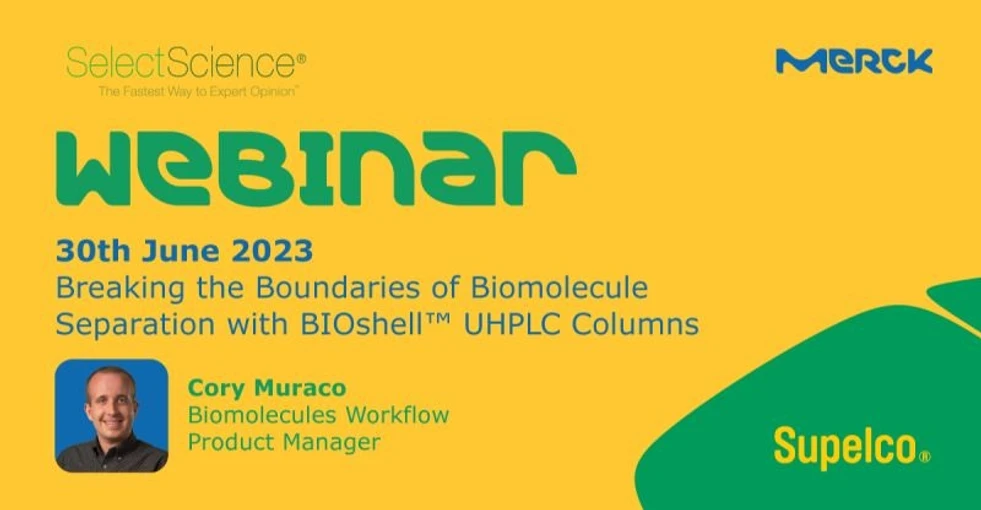
Breaking the Boundaries of Biomolecule Separation with BIOshell™ UHPLC Columns
Superficially porous particles (SPPs) have advantages over traditional fully porous particles (FPPs) when packed into columns for chromatographic separation of biomolecules. Due to the presence of a solid silica core, analytes have a smaller distance to travel within a particle, thus minimizing diffusion due to mass transfer effects. Combined with a large pore diameter and a thin, porous shell, these particles can yield highly efficient peaks even for large proteins such as monoclonal antibodies.
In this webinar, you will learn about the advantages of using SPP-packed BIOshell™ columns for various large molecule separation challenges. Aspects of peptide mapping, intact analysis and middle-up analysis will be reviewed, and strategies for improving these assays will be provided. In addition, a unique 1.5 mm I.D. column geometry and its advantages in improving sensitivity and making methods more sustainable will be reviewed. Finally, strategies for characterizing oligonucleotides will be discussed in relation to how BIOshell™ can assist in analyzing this class of biomolecule.
Key learning objectives
Discover the importance of SPP particle architecture (pore size and shell thickness) and how it contributes to high-efficiency separations of biomolecules
Explore how column chemistry can play a role in improving peptide mapping accuracy
Learn how extra column dispersion can affect chromatographic performance and discover strategies to mitigate it
Who should attend?
R&D scientists/method developers (from Pharma, Clinical, University)
R&D supervisors/managers (from Pharma, Clinical, University)
QC scientists (from Pharma, Clinical, University)
QC managers (from Pharma, Clinical, University)
Presenter: Cory E. Muraco (MilliporeSigma)
Cory Muraco is the Biomolecule Workflows Product Manager at MilliporeSigma, Bellefonte, USA. Muraco joined the company in 2013, starting in the Chemical Standards division, developing and validating analytical methods for testing the purity of certified reference materials using GC and LC methods. In 2022, Muraco started his current role, where he is tasked with supporting the design, development, and execution of the marketing and R&D strategies around MilliporeSigma’s bioanalytical strategy.
Presenter: Jemima Arnold (Editorial Team, SelectScience)
Jemima studied Cellular and Molecular Medicine at the University of Bristol, UK, and as a member of the Editorial team, she now plays an integral role in shaping the content on SelectScience.


