Explore What’s Possible with MRT – Uncompromised Performance
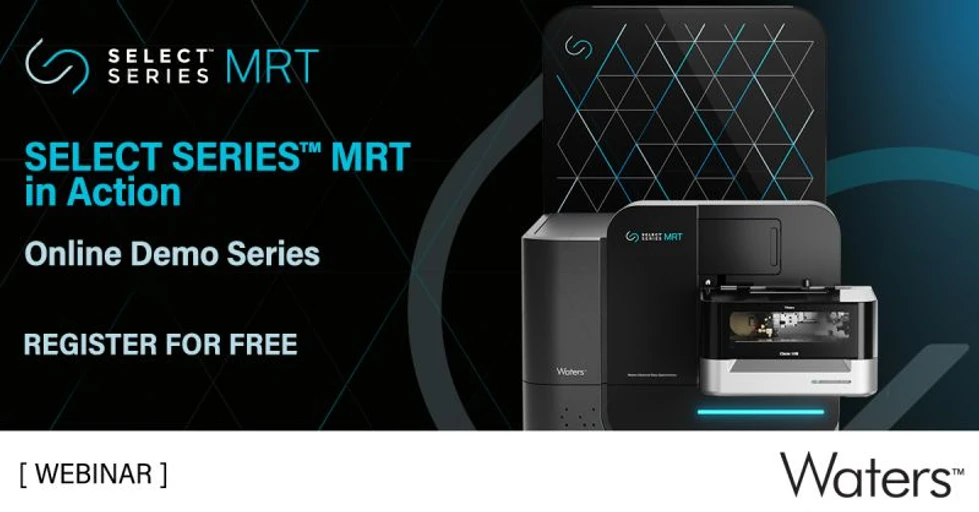
Join us for this exciting new demo series where we take you into our application laboratories to see the SELECT SERIES MRT in Action and explore different workflows from the beginning to the end. Register now for the demo series and see for yourself how MRT can expand the possibilities in your research.
We kickstart the series with an overview and demonstration of the technology and highlight the unique benefits when high mass resolution and sub-ppm accuracy combine with the speed of Time-Of-Flight.
Join us to see how to run samples, experience the latest software for data acquisition, visualization, and interpretation. Register now for this event and see for yourself how MRT can expand the possibilities in your research.
The session will conclude with a live Q&A where members of the Waters Discovery MS portfolio science team will be on hand to answer all of your questions.
Why Should You Attend?
- Learn about the operation of the novel SELECT SERIES MRT technology and see it in Action!
- Find out about the unique capabilities of this instrument and how the different acquisition modes can be applied to measure complex samples.
- Discover the benefits and flexibility of this technology for a wide range of applications including small and large molecule LC-MS and Imaging.
Presenter: Martin Palmer (Principal Consulting Scientist, MS Discovery Program, Waters Corporation)
Martin Palmer is a Principal Scientist in the Discovery Mass Spectrometry team at Waters Corporation. He has over 20 years’ experience at Waters, most recently leading the scientific contribution required for the evaluation, development and commercialization of new MS technologies including the SELECT SERIES Cyclic IMS and MRT.
Martin collaborates extensively with customers to ensure their analytical challenges are understood and addressed by the next generation of high resolution mass spectrometers.
Martin received his Ph.D. in Mass Spectrometry from Sheffield Hallam University, UK (1999). His scientific work has aided the commercialisation of over 10 mass spectrometers, resulted in over 30 publications and two patents.