Get Prepared for Lipidomics 2.0 with Waters 2nd Edition
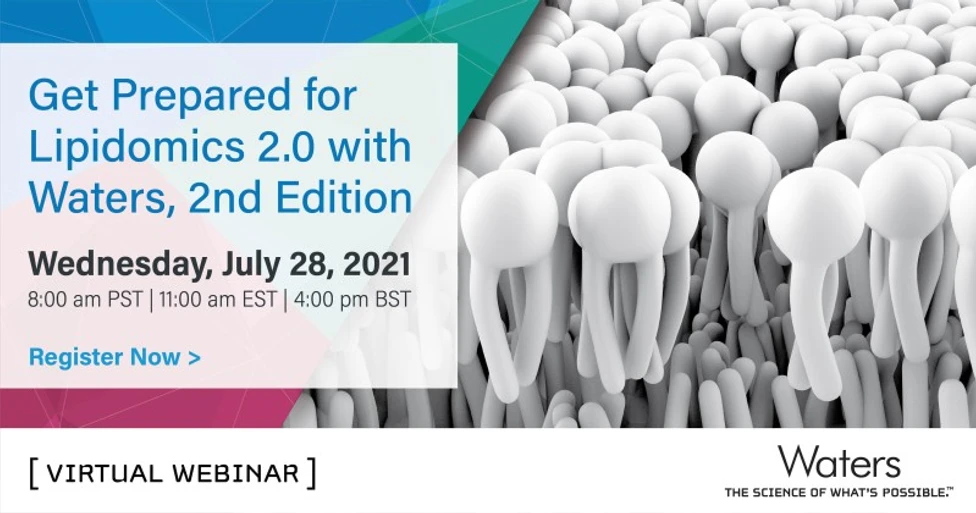
Lipidomics can be a challenging analytical pursuit. The rewards are obvious with lipids playing major roles in biological processes associated with disease, but by the very nature of their chemistry, they can pose major challenges in both chromatography, identification and quantification. In this webinar series we will discuss some of the latest analytical approaches which have been developed to address these hurdles.
We will hear from researchers in lipidomics using mass spectrometry to quantify lipid expression and determine the spatial localization of lipids in tissue samples. We will introduce the concepts of cloud computing tools to help review quality control in large lipidomics studies and the use of DESI imaging for the study of liver disease.
Agenda
The Combined Use of C18 and HILIC Separations for Discovery Lipidomics
Presenter: Jace W. Jones, Ph.D. (Assistant Professor and Associate Director of the Mass Spectrometry Center, University of Maryland)
Dr. Jones received his B.S. degree from Whitworth University. He obtained his Ph.D. from the Department of Chemistry at the University of Washington under the mentorship of Dr. František Tureček. Following his PhD, he held a post-doc position in the laboratory of Dr. David R. Goodlett (University of Washington). He then spent several years in industry investigating the role of environmental contaminants on land resources and human health. Following his transition back to academics, he progressed from research scientist to research faculty under the mentorship of Dr. Maureen A. Kane (University of Maryland). His research program seeks to understand the synergistic relationship between chemistry and biology, and how this profound interaction influences human health. Specifically, his lab is focused on developing mass spectrometry-based analytical platforms to probe the structure/function dynamics of lipids. The knowledge gained by comprehensively characterizing lipid structure and anchoring structure to quantitative abundance provides a unique opportunity to investigate how disruption in lipid metabolism impacts human health. He has been awarded the ASMS Research Award (2020) and the New Investigator Award (2020) from the American Association of Colleges of Pharmacy (AACP).
Spatial metabolic imaging of non-alcoholic fatty liver disease using desorption electrospray ionization mass spectrometry
Presenter: Patcharamon Seubnooch (PhD student, Department for BioMedical Research, Hepatology, University of Bern)
Patcharamon is a a PhD student from Hepatology, Department for BioMedical Research, University of Bern, Switzerland. Her research interests are in the field of spatial metabolomics and lipidomics analysis. Currently, her PhD project is focusing on spatial metabolic imaging of non-alcoholic fatty liver disease using Desorption electrospray ionization mass spectrometry (DESI-MS).She has optimized the spatial lipidomics for biological samples in pre-clinical and clinical sample.
Redefining clarity in mass spectrometry imaging with the SELECT SERIES MRT
Presenter: Emmanuelle Claude (Consulting Scientist, Waters Corporation)
Miss Emmanuelle Claude (Master in Fine Chemistry and Business and M.Phil in spectroscopy analysis in organic chemistry and biology) has started at Waters Corporation in October 2000 as an Application Chemist in the Proteomics and Genomics Marketing group, developing automated Peptide Mass Fingerprint (PMF) MS methods using a MALDI-TOF mass spectrometer.
Over the years she developed a number of methods in the proteomics analytical space using MALDI TOF and naturally moved in starting the development of Mass Spectrometry Imaging (MSI) at Waters corporation over 12 years ago.
She has been involved with hardware and software R&D to ensure that the solutions are fit-for-purpose for the MSI community and beyond. She has worked extensively with the main MSI leaders in Europe and the US such as Prof Heeren in the Netherlands, Prof Clench, Prof Takats and Bunch in the UK and Prof Caprioli in the US. She has been a Principal Scientist since 2014 and became a Consulting scientist in 2021. She is managing the MS imaging application team at Waters where data are generated for collaborations and marketing activities (i.e. application literature, customer presentation, papers, posters...), hardware and software requirements are defined for the R&D teams. The team evaluates and develops new applications & methods for imaging by both MALDI and DESI mass spectrometry, support sales staff with customers visit and demonstration laboratory.
Key Learning Objectives
- How the application of technology and informatics are used to overcome the challenges in lipidomics
- The importance of quality control and standardization in lipidomics research
- How desorption electrospray ionisation (DESI) can be used to map the spatial distribution of lipids in tissue samples
- The roll of high-resolution mass spectrometry in tissue imaging
Who should attend
- Researchers studying lipids in biomedical research applications
- Those interested in maximizing liquid chromatography methods for lipidomics
- Anyone interested in learning about state-of-the-art imaging techniques using mass spectrometry
- Researchers looking to start lipidomics efforts for the first time, moving from other discovery omics areas or just wanting to expand their lipidomics research
This is part 2 of our Get Prepared for Lipidomics webinar series. To access part 1, please click this link.
Presenter: David Heywood (Senior Manager Biomedical Research Marketing, Waters Corporation)
David has 28years of experience in the mass spectrometry business andhasperformed many rolesboth in the UK and the Americas,including technicalhardware and software support, sales,marketingandbusiness development.Now based at Waters’ Mass Spectrometry Head Quarters in Wilmslow UK,Davidhas helped commercializemany of Waters successful high-resolution mass spectrometrybasedsolutions for discovery omicsandis now responsible for global marketing strategies of these platforms.