

Ion-Pair Reversed‑Phase LC Method Development for sgRNA Impurity Analysis
sgRNAs define CRISPR‑Cas targeting and require monitoring of key quality attributes, such as purity assessment by quantifying closely related impurities, including N‑1 truncated species from synthesis. Because long RNA oligos have complex structures that demand high‑resolution separations, ion‑pair reversed‑phase LC is used for its reliable retention, selectivity, and simple UV detection. In this study, an AQbD approach aligned with ICH Q14 employing risk assessment and design of experiments to identify critical method parameters and optimize impurity resolution of a sgRNA. The resulting method, implemented on a Biozen Oligo reversed‑phase column, provides robust, routine‑ready sgRNA impurity profiling.
Key Learning Points
- Understand the impact of different ion-pairing reagents and organic solvents.
- Learn how to identify critical method parameters affecting resolution.
- Find strategies for optimizing chromatographic conditions following a statistical design.
Who Should Attend
- Any scientists developing LC methods for long RNA, such as sgRNA, for impurity analysis.
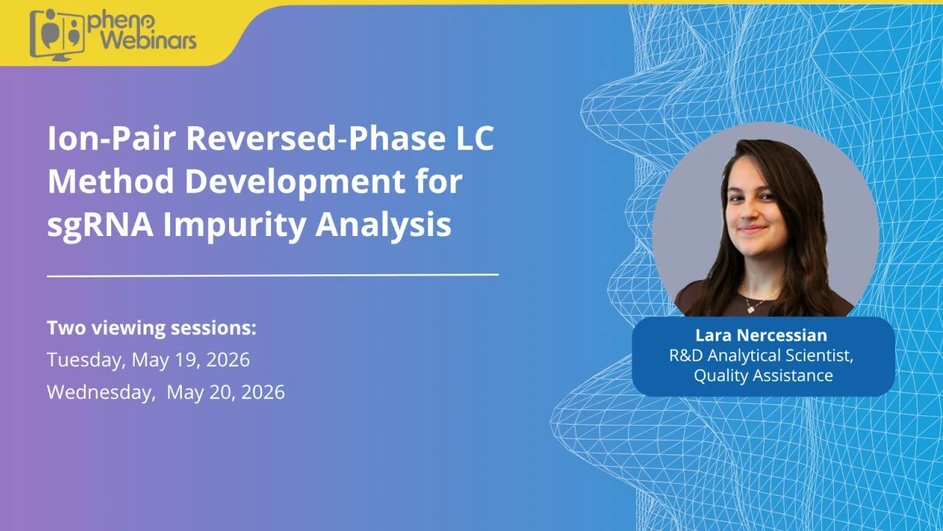
Speaker: Lara Nercessian (R&D Analytical Scientist, Quality Assistance)
Lara Nercessian is an R&D Analytical Scientist at Quality Assistance, where she has spent the past three years developing and optimizing chromatographic methods for nucleic acid based therapeutics such as sgRNA, oligonucleotides and mRNA. She holds an Engineering Degree in Chemistry from ECPM Strasbourg (France) and a Master’s degree in Experimental Techniques in Chemistry from Valencia (Spain). Her expertise includes liquid phase chromatography, AQbD driven method development and impurity profiling, and she is the author of a publication on the robustness evaluation of a WAX method for oligonucleotides. In this webinar, Lara will present an AQbD guided IP RP HPLC method for sgRNA analysis, highlighting the key parameters that influence separation performance and sharing practical insights on how these strategies can support the characterization of nucleic acid modalities.


