

From pixels to proteomes: Advanced spatial proteomics workflows for transformative biological insights
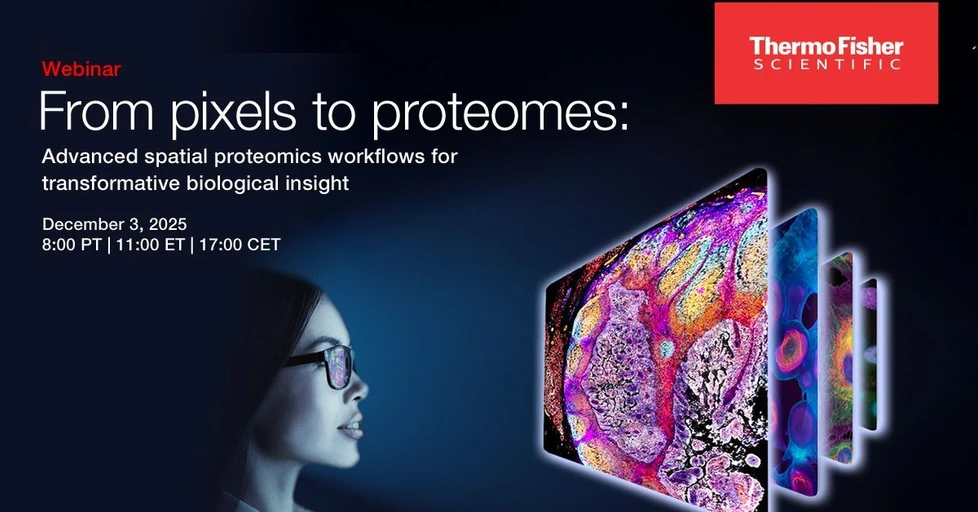
Spatial proteomics represents a revolutionary frontier in molecular biology, enabling researchers to explore protein expression while preserving the critical spatial context of tissue architecture. Antibody-based spatial methods have provided valuable insights into tissue organization and cellular interactions, and now mass spectrometry-based approaches offer complementary capabilities to extend these discoveries. By combining the specificity of imaging with the comprehensive profiling power of mass spectrometry, researchers can now achieve unprecedented proteome depth—capturing thousands of proteins from minimal sample inputs while maintaining spatial information.
Join our webinar to discover two cutting-edge mass spectrometry-powered spatial proteomics approaches. Dr. Lisa Schweizer will present on Deep Visual Proteomics (DVP), an innovative workflow that combines high-plex imaging with laser microdissection and Thermo Scientific Orbitrap mass spectrometers to achieve deep proteomic profiling of specific cell populations. Dr. Max Ruwolt will demonstrate the Syncell targeted extraction workflow, which enables precise isolation and molecular characterization of selected populations from complex tissue environments.
This webinar will demonstrate how Orbitrap-powered spatial proteomics enables unbiased discovery of novel proteins and pathways, revealing hidden biological insights beyond conventional methods
Learning Objectives:
- Learn how mass spectrometry can benefit spatial proteomics research
- Learn about Deep Visual Proteomics and targeted extraction workflows for spatial analysis
- Discover practical applications that demonstrate how spatial proteomics reveals new biological insights
Presenter: Max Ruwolt, PhD, Leibniz-Forschungsinstitut für Molekulare Pharmakologie (FMP) Staff Scientist Mass Spectrometry
Dr. Max Ruwolt earned both a Bachelor’s and Master’s degree in Biochemistry from Freie Universität Berlin before pursuing doctoral studies at the Leibniz-Forschungsinstitut für Molekulare Pharmakologie (FMP) in Berlin. In October 2024, Dr. Ruwolt completed a PhD in the laboratory of Fan Liu, where his research centered on advancing cross-linking mass spectrometry (XL-MS). Dr. Ruwolt focused on developing novel acquisition strategies for the identification and quantification of cross-linked peptides, while also addressing error control through custom software solutions and benchmarking datasets.
Since 2024, Dr. Ruwolt has been a Staff Scientist in the FMP Mass Spectrometry Core Facility, where he supports internal and external researchers through data analysis, user training, and facility management. In this role, Dr. Ruwolt has contributed to collaborative projects, including the analysis of SynCell samples in partnership with Martin Lehmann’s Imaging Facility and Volker Haucke’s laboratory at FMP Berlin.
Dr. Ruwolt’s expertise bridges methodological innovation and applied proteomics, with a strong focus on empowering the research community through both technical development and collaborative science.
Presenter: Lisa Schweizer, PhD, OmicVision Bioscience, Head of Deep Visual Proteomics
Lisa Schweizer earned her B.Sc. and M.Sc. from the Technical University of Munich before completing her Ph.D. with Prof. Matthias Mann at the Max Planck Institute of Biochemistry. Her doctoral research focused on clinical and spatial proteomics in COVID-19 and ovarian cancer, the latter in collaboration with the University of Chicago. As Head of Deep Visual Proteomics at OmicVision Biosciences, she is pioneering spatial medicine, working to bridge mass spectrometry-based discovery and translational proteomics into the clinic.


