Pushing the Limits of N-1 for Long RNA
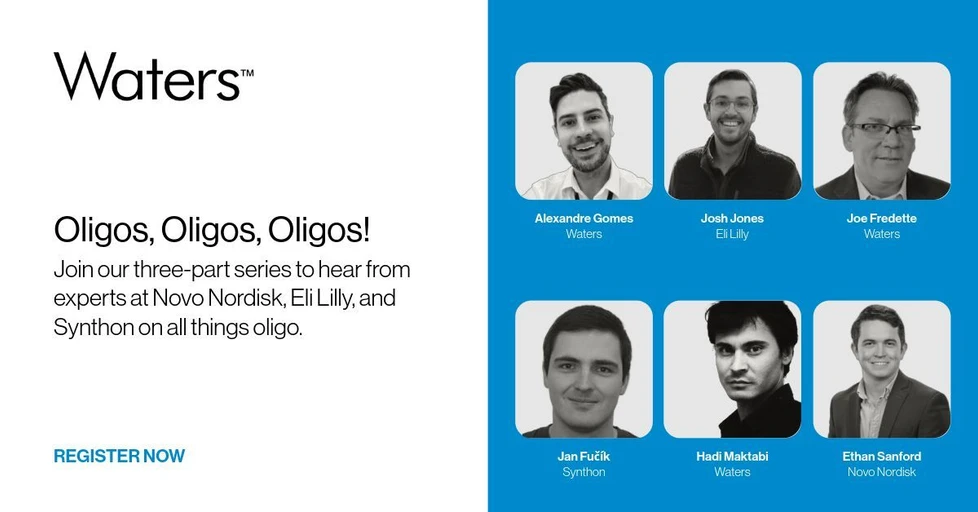
2nd Annual Oligos, Oligos, Oligos!
A special 3-part Live Webinar series focused on Oligonucleotide Analysis from Waters Corporation and Collaborators.
Seminar Series Summary
Oligonucleotide therapeutics are helping the world address previously untreatable diseases, and their clinical pipeline continues to see strong growth. In various forms, including small interfering RNA (siRNA), Antisense Oligonucleotides (ASOs), CRISPR single guide RNA (sgRNA), and others, these nucleic acid modalities often incorporate a range of modified nucleotides for enhanced stability, and are increasingly conjugated to tissue-specific ligands (GalNAc, lipids, peptides, mAb’s, etc.) to effect targeted cell delivery. To advance their development, these molecules and their impurities must be fully characterized, and their stability and pharmacokinetic properties must be accurately assessed.
In this webinar series, Waters’ scientists and collaborators from Novo Nordisk, Eli Lilly, and Synthon will provide state-of-the-art updates on the tools and techniques used to both confirm their identity and purity, and to quantify their pharmacokinetic properties in biological systems. Join us as we delve into the science of oligos and explore the power of LC and LC-MS based approaches to analyze them.
EPISODE 2
sgRNA Single-Nucleotide Resolution by Ion-Pairing Reversed-Phase Chromatography
- Speaker: Josh Jones /Eli Lilly
In this episode, Eli Lilly will discuss the development of advanced analytical methods for single-stranded guide RNAs (sgRNAs), key therapeutic tools in CRISPR/Cas9 genome editing. Unlike shorter oligonucleotide therapeutics such as siRNAs and ASOs, sgRNAs pose unique challenges due to their longer sequences and complex folding. Lilly’s team systematically evaluated chromatographic parameters and discovered that more hydrophobic ion-pairing reagents, along with optimized flow rates and temperatures, significantly improved separation of long truncation impurities and resolution near the full-length product. The resulting method achieves single-nucleotide resolution while maintaining compatibility with mass spectrometry, offering unprecedented insights into sgRNA impurity profiles. This breakthrough will support toxicological studies and streamline process development for next-generation genetic medicines.
Advanced LC-MS workflows for RNA Therapeutics to Ensure Product Quality and Process Consistency
- Speaker: Hadi Maktabi / Waters Corporation
As the therapeutic landscape increasingly incorporates longer RNA modalities, their longer sequence and structural complexity present significant analytical challenges. Robust strategies are therefore essential to ensure product quality and consistency. This presentation will demonstrate how high-resolution LC-MS workflows enable comprehensive monitoring of critical quality attributes (CQAs) and provide unambiguous sequence confirmation of these molecules. Case examples will highlight how advanced LC-MS methodologies deliver the resolution and specificity required for accurate characterization, supporting both process development and quality control of RNA-based therapeutics.
Presenter: Josh Jones (Advisor – Analytical Chemistry, SMDD
Eli Lilly)Josh Jones received his bachelor’s in Chemical Engineering from University of Illinois in 2018. He later received his Ph.D. in Chemistry from the University of Michigan under supervision of Kristin Koutmou and Robert Kennedy where he developed biochemical and analytical methods to characterize the endogenous post-transcriptional RNA modification landscape. In 2023, Josh started at Eli Lilly as an Advisor – Analytical chemistry, where he is developing analytical strategies and methodologies for Lilly’s genetic medicine portfolio.
Presenter: Hadi Maktabi (Principal Biopharma Specialist, Waters Corporation)
Hadi Maktabi, PhD, is the Biopharma Business Development Specialist at Waters, supporting customers across the U.S. West and Canada in advancing analytical solutions for therapeutic development. In this role, he partners with biopharma scientists to apply cutting-edge LC-MS and biophysical technologies to address complex drug development challenges.
Prior to joining Waters, Hadi worked at ProteinSimple, where he supported biopharma researchers in applying capillary electrophoresis–based techniques (cIEF, CE-SDS, and SimpleWestern) for biotherapeutic characterization. He earned his PhD in Molecular Cell Biology from Washington University in St. Louis, where his dissertation research focused on protein palmitoylation dynamics and their role in membrane binding, trafficking, and spatial organization of signaling proteins, notably in regulating GPCR signaling.