Leveraging Automation for Efficient LC-MS Sample Prep for Protein-Based Therapeutics
Monoclonal antibodies and various protein molecules derived from antibodies are a very important branch of new drugs being developed in all therapy areas. Developability assessment is critical in establishing early that such molecules can advance successfully from discovery to development. This entails examination of multiple physicochemical properties, with LC-MS results arguably comprising the most significant readout. Typically, multiple protein sequences are subjected to a variety of stress conditions (high and low pH, oxidation, high temperature, etc.) to assess and identify sequence liabilities, that is amino acids that can undergo modifications (deamidation, cyclization, oxidation, disulfide bond scrambling), which may adversely affect biological activity or induce immunogenicity. This entails the generation and analysis of dozens of peptide maps, a tedious process prone to human error that is avoidable with automation.
Once one or two lead candidate sequences have been identified as having the least significant sequence liabilities, similar analyses are performed in support of cell culture and purification development and to assess stability in one or more formulations. LC-MS analyses of peptide maps and of glycosylation profiles are carried out. Again, automation can mitigate the tedium of manual sample processing and reduce human error. Finally, at the tail end of development, when a process has been finalized and material for animal studies and GMP material for human clinical studies is produced, automation is critical for the reproducibility of LC-MS analyses of peptide maps and glycan profiles that are used for the comprehensive and detailed characterization of drug product and to demonstrate process consistency.
Here’s what you’ll learn:
- Key challenges that Analytical Chemists face when applying LC-MS to generate peptide maps and glycan profiles of biopharmaceuticals.
- The role that Laboratory Automation plays in terms of reducing tedious and error-prone sample preparation steps that are necessary prior to characterizing biopharmaceuticals by LC-MS.
- Leveraging the easy-to-use OneLab software suite and the OneLab Online Protocol Library to develop LC-MS sample preparation methods for biopharmaceuticals that can be automated on the Andrew+ Pipetting Robot.
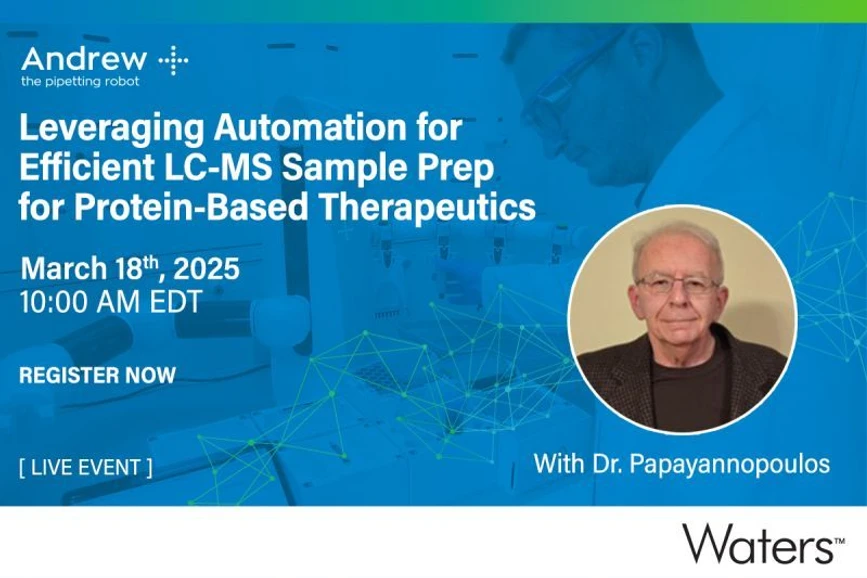
Presenter: Ioannis Papayannopoulos (PhD, Principal, Analytical Biotechnology Consulting, LLC)
Dr. Papayannopoulos has decades of experience with multiple facets of Analytical Protein Chemistry R&D, spanning basic discovery research to late-stage biopharmaceutical development at Biotechnology companies that have included Biogen, Astra Zeneca, Celldex Therapeutics, and Dragonfly Therapeutics. He also served as Director of the Proteomics Core Facility at the MIT Koch Institute for Integrative Cancer Research.
A noted expert in Protein Mass Spectrometry with 40+ peer reviewed publications to his credit, Dr. Papayannopoulos made fundamental contributions to the field of peptide sequencing using mass spectrometry. He has deep expertise in applying ion mobility mass spectrometry to study the higher order structure of proteins and leveraging mass spectrometry-based multi-attribute monitoring (MAM) to study critical quality attributes (CQAs) of protein therapeutics.
Dr. Papayannopoulos graduated with a PhD in Organic Chemistry from the Massachusetts Institute of Technology (MIT) under the supervision of Prof. Klaus Biemann and an A.B in Chemistry from Bowdoin College.