

Insights on Column Selection for LC-MS/MS Clinical Research
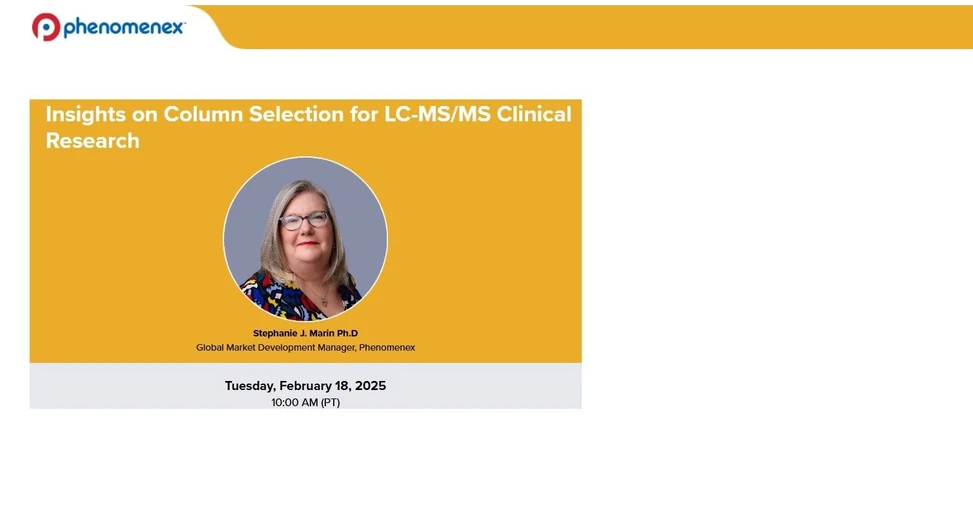
This webinar will provide insights on column selection for clinical research applications based on analyte properties, stationary phase characteristics, and instrumentation. Reversed phase separation mechanisms and stationary phase modifications, and how they affect retention and selectivity will be presented. How particle size and porosity affect chromatographic efficiency will be explained. Fully porous vs superficially porous HPLC and UHPLC columns and their use in clinical research will be discussed. LC column selection based on analyte and column properties will be described. Lastly, several studies will be presented to demonstrate how to select the best column.
Key Learning Points
- Explain how analyte properties affect LC column choice
- Review differences in column chemistry and its impact on separation
- Describe criteria for choosing the best LC column for clinical research applications
Who Should Attend
Researchers, scientists and analysts who want to learn more about LC column selection for LC-MS/MS Methods. Lab managers looking to start or increase use of LC-MS/MS in their laboratories. Laboratorians doing method development and implementation for clinical research.
Presenter: Stephanie J. Marin Ph.D (Global Market Development Manager, Phenomenex)
Stephanie J. Marin is the Clinical and Forensics Global Market Development Manager at Phenomenex. She received her Ph.D. in chemistry from Arizona State University, and has expertise in sample preparation, liquid chromatography and mass spectrometry. She has over 10 years of experience developing and validating clinical methods from her tenure at the ARUP Institute for Clinical and Experimental Pathology. Dr Marin has worked in marketing, product development, and applications development, in addition to customer facing roles in customer and technical support and service and customer education and training. She has also held positions at Hamilton Company, Selerity Technologies and Biotage, and in analytical services for specialty chemicals and polymers at Rohm and Haas (now Dow). She was also a supervisor at an EPA certified laboratory. She is the author of over 30 peer reviewed publications and book chapters and over 100 abstracts presented at national and international meetings.


