Quantification of Thyroglobulin in Serum for Clinical Research using SISCAPA Workflow Combined with LC-MS/MS
LC-MS/MS is the gold standard for a wide range of analytical methods in clinical laboratories, with its orthogonality providing powerful levels of selectivity and analytical sensitivity. The Waters Total Solution LC-MS/MS Workflow has been designed to improve the user experience of LC-MS/MS to allow more users to successfully utilize the technique in their laboratories. The workflow can be adopted for a range of small molecules, as well as large molecules, such as the large glycoprotein, thyroglobulin.
Using thyroglobulin as an example, we will guide you through aspects of large molecule method development and highlight steps of the workflow that minimize user touch-time, maximize throughput and improve turnaround time. Aspects of the workflow include:
- Improving the workflow reproducibility with full automation of the Stable Isotope Standards and Capture with Anti-Peptide Antibodies (SISCAPA™) approach using the Andrew+ Pipetting Robot
- Increasing throughput and robustness with Parallel Column Regeneration
- Same day reporting of results using the power of UPLC-MS/MS with waters_connect for IVD and Quan Review
Who Should Attend?
- Laboratory professionals and clinicians who are eager to learn about the benefits of LC-MS/MS in the clinical laboratory workflow
- Laboratory professionals who are seeking to expand their knowledge into using LC-MS/MS for the quantitative analysis of peptides and proteins for clinical research
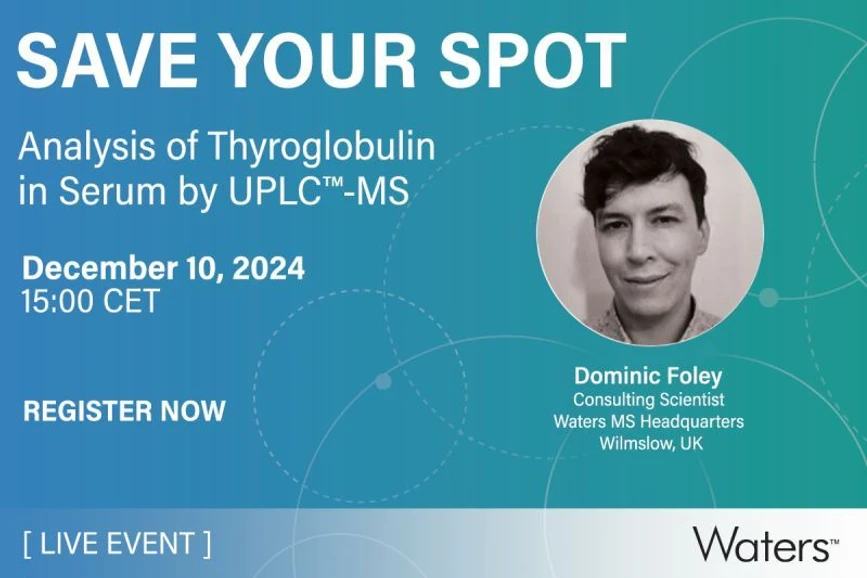
Presenter: Dominic Foley (Consulting Scientist, Waters Corporation)
Dominic Foley is a Consulting Scientist working at Waters MS Headquarters in Wilmslow, UK. Having joined the company in September 2013, he has specialized in the development of LC-MS/MS clinical research applications, with a focus in endocrinology, particularly steroid hormone analysis. In his role, he also collaborates with clinical customers in the development and implementation of LC-MS/MS methods in their laboratories.
Dominic has worked in separation sciences for 17 years, following his ambition of improving the quality of healthcare. He started his career with ICON Development Solutions, a CRO in the north of the UK, where he worked as a LC-MS/MS method development and validation scientist supporting DMPK studies in drug discovery. In 2012, he joined Thermo Fisher Scientific to work in their Chromatography R&D team as a Technical Support Specialist, working on the development of new chromatography and sample preparation products.
Dominic received his BSc (Hons) in Biochemistry from the University of Manchester in 2006. He has presented his work at conferences around the world and has publications in journals such as Clinical Chemistry and Laboratory Medicine, Analytical Chemistry and Journal of Chromatography A.