Multi-attribute quantitation of XDCs with Multi-Angle Light Scattering
Event Overview:
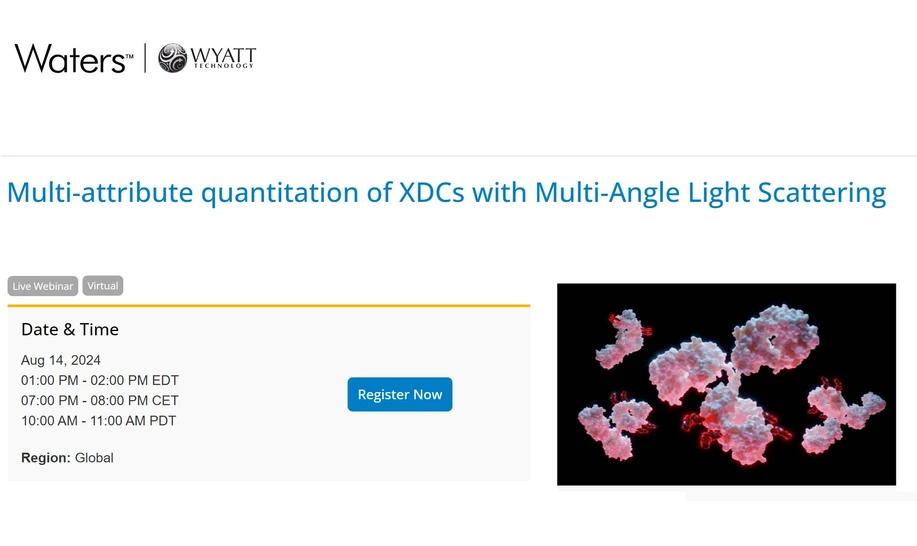
XDCs, such as antibody-drug conjugates (ADC), antibody oligo conjugates (AOC), ribonucleoproteins (RNP), and conjugate vaccines are growing rapidly due to advances in their component technology and their promise of higher efficacy compared to traditional therapies. However, these complex hybrids are more heterogeneous than traditional biologics, posing additional analytical challenges. Quality attributes such as composition, aggregation, purity, and conformation can all affect the efficacy and toxicity of the product.
In this online seminar, we will demonstrate the value of light scattering in XDC development and its potential application in quality control (QC) as part of a release assay. We will explore how light scattering provides reproducible and comprehensive quality attribute data in a single platform and provides savings on time and resources for the development of complex XDC drugs.
Key Learning Objectives:
- How light scattering across the workflow from development to QC for complex biologics
- What parameters multi-angle light scattering (MALS) can provide for conjugated species like ADCs
- The return on investment when running a multi-attribute test
Who Should Attend:
- Scientists in CMC or QC looking to enhance their knowledge of light scattering
- Researchers investigating methods for characterizing complex hybrid biologics
- Lab managers or scientists focused on enhancing lab efficiency while maintaining thorough investigational standards
Presenter: Hongjiang "Leo" Liu, Ph.D. (Global Training Manager and Application Scientist)
Leo Liu joined the Analytical Sciences team at Wyatt in 2022 with a background in synthetic biochemistry and functional materials. Specialized in protein-based applications, he assists customers in identifying the best solution for their analytical needs, leveraging his expertise in multi-angle static and dynamic light scattering as well as a wide range of other leading techniques for biomolecular characterization. Before joining Waters Wyatt Technology, he was a startup biotech entrepreneur and an expert-in-house at the Hult Prize Foundation. He received his Ph.D. from the University of California, Los Angeles (UCLA), where he researched and built novel designer enzymes that can capture CO2 and store them as biofuels and biopolymers with renewable electricity.