Enhancing protein detection and lipid class coverage during the analysis of tuberculosis granulomas using DESI imaging and Cyclic IMS
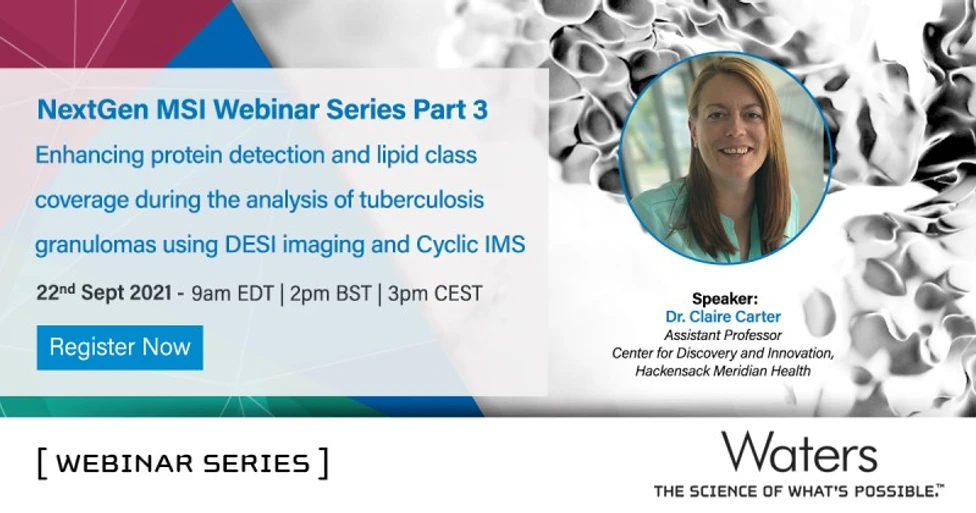
Despite the discovery of antibiotics, Mycobacterium tuberculosis (Mtb), remains a serious global health threat and was responsible for 1.4 million adult and 230 thousand child deaths in 2019. Granuloma formation is a hallmark of the host-response to Mtb infection and results in diverse environments that pose significant challenges to both immunological resolution and chemotherapeutic clearance of infection.
Single and multiple pass experiments in the cyclic ion mobility cell were conducted to evaluate the impact of ion mobility resolution on the number and type of ions detected.
Key Learning Objectives:
- Discover how MS Imaging is being used in clinical and lipidomic investigations.
- Find out how ion mobility resolution improves the detection and identification of a panel of key biological markers and the added benefit Cyclic IMS provides.
- Learn how improvements in imaging techniques, including DESI XS enhance the quality of images and information gleaned from biopsy and tissue samples.
Who Should Attend:
- Everyone with a passion for imaging mass spectrometry, especially scientists seeking the latest advances to accelerate their research, with focus on clinical and biomedical research.
- Clinical research groups and academics
Presenter: Dr Claire Carter (Assistant Professor, Center for Discovery and Innovation, Hackensack Meridian Health)
Claire Carter, Ph.D is an Assistant Professor in the Department of Pathology, Hackensack Meridian School of Medicine and a Research Assistant Member at the Center for Discovery and Innovation, Hackensack Meridian Health. She is Co-Director of the Mass Spectrometry and Analytical Pharmacology Shared Resource, a joint venture between Georgetown Lombardi Comprehensive Cancer Center and the Center for Discovery and Innovation, Hackensack Meridian Health. Dr. Carter completed her Ph.D in mass spectrometry imaging at the University of Birmingham, UK, under the supervision of Professor Josephine Bunch (2012). She then moved to the US for a postdoctoral appointment at the University of Maryland Baltimore (2013-2018). This was followed by a short appointment at the Public Health Research Institute, Rutgers University, New Jersey (2018-2019), prior to her move to Hackensack Meridian Health’s newly constructed research center, the Center for Discovery and Innovation (2019).
Dr. Carter possesses a rare translational background that combines expertise in bioanalytical chemistry, clinical histopathology and biomedical science. Dr. Carter’s research group is multifaceted and centers on the use of next generation imaging techniques, with a particular focus on mass spectrometry imaging, and how this is utilized at the chemistry-biology interface to probe the biomolecular networks that drive disease progression. Her primary areas of research are neuro-oncology and infectious disease.