

EuBIC-MS Winter School 2026
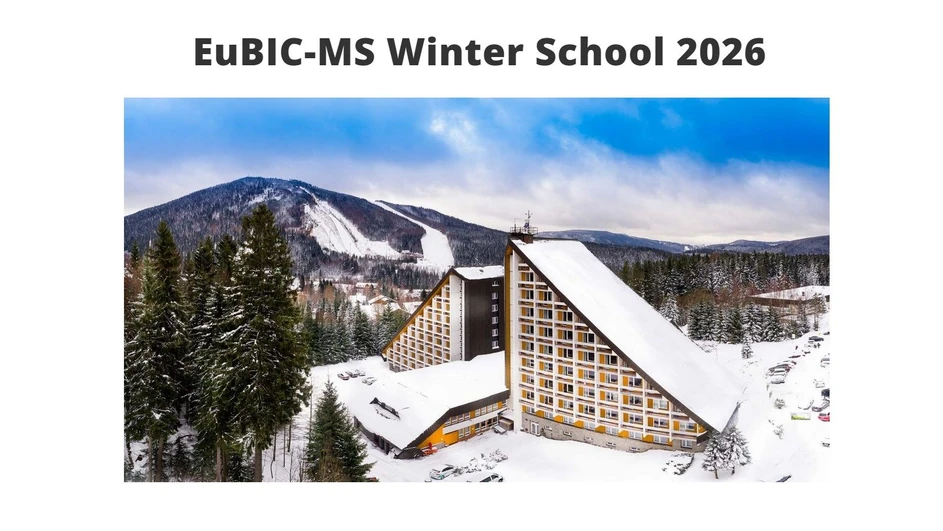
Join us for the EuBIC-MS Winter School 2026 – a biennial meeting focused on computational approaches for mass spectrometry–based omics. The event brings together leading scientists and early-career researchers for keynote lectures, hands-on workshops, and networking opportunities, fostering collaboration and knowledge exchange within the MS bioinformatics community.
Registration
- Registration opens: 15 October 2025
- Early bird registration closes: 19 November 2025
- General registration closes: 10 December 2025
Registration fees
Early bird registration
- Academic: €500
- Industry: €700
General registration
- Academic: €600
- Industry: €800
The registration fee includes:
- Access to all main Winter School sessions (keynotes, workshops, poster session, social event, …)
- Receipt of all main conference materials
- Coffee breaks and lunches on five conference days
The registration fee does not include:
- Travel costs
- Hotel accommodation
- Breakfast
- Dinner
- Additional social activities
Capacity is limited to 200 participants, and places are allocated on a first-come, first-served basis.
After registering, do not forget to book your accommodation with the provided booking code, and to submit your poster abstract.
Abstract submission
- Abstract submission opens: 15 October 2025
- Abstract submission closes: 19 November 2025
Present your work with a poster or flash talk
Abstracts are submitted for poster presentations, with the option to apply for a flash talk to promote your poster. All submissions that meet our quality criteria and are relevant to the general audience of the event will be accepted for a poster presentation. For flash talks, the organizing committee will select a subset of abstracts based on the same criteria of quality and relevance. Abstract submission, flash talk applications, and EuPA Travel Grant applications are handled through the same online form.
Program
Keynote speakers
Armin Soleymaniniya
Armin Soleymaniniya is a PhD candidate in the Associate Professorship of Computational Mass Spectrometry at the Technical University of Munich. His research centers on peptide identification, large-scale data integration and reuse, and providing proteomics data in an accessible and FAIR way. He is a leading developer of ProteomicsDB, with a focus on large-scale data integration and the development of cross-species features. In addition, he contributes to the Proteomes that Feed the World project, which applies proteomics to advance agricultural sustainability and food security. By combining predictive models, workflow automation, and open data infrastructures, his work enhances the scalability and reproducibility of proteomics analysis and supports new applications across species.
Arthur Declercq
Arthur Declercq is a postdoctoral researcher in the CompOmics group at Ghent University, where he recently completed his PhD in Health Sciences. With a background in biomedical sciences and a strong interest in immunology and bioinformatics, his research focuses on developing computational methods for immunopeptidomics. He has created algorithms to identify MHC-bound epitopes, which are central to advancing vaccine design for cancer and infectious diseases. He is the developer of TIMS²Rescore and received the 2023 PhD Innovation Café award from VOKA and UGent. By combining immunology with AI-driven bioinformatics, his work contributes to overcoming current challenges in vaccine development.
Claire Koenig
Claire Koenig is a postdoctoral researcher in the Olsen Group at the University of Copenhagen. With a background in analytical chemistry and mass spectrometry–based proteomics, her work focuses on developing streamlined and high-throughput workflows that expand the capabilities of proteomics. She has applied these methods across diverse fields, from palaeoproteomics to quantitative phosphoproteomics of human cell systems. Her current research centers on advancing phosphoproteomics to investigate cellular signaling and regulatory processes, with the aim of broadening the accessibility and impact of mass spectrometry technologies across biomedical research.
Hannah Boekweg
Hannah Boekweg is a researcher specializing in computational methods for single-cell proteomics. She recently completed her doctorate in bioinformatics, where she developed new algorithms for protein quantification and statistical models tailored to the unique challenges of single-cell data. Her work also addresses study design, including approaches for determining sample size requirements in time-course trajectory analyses. By advancing computational frameworks for single-cell proteomics, she contributes to improving the accuracy, interpretability, and scalability of this rapidly emerging field.
Jonas Scheid
Jonas Scheid is a PhD candidate at the University Hospital Tübingen, working within the Quantitative Biology Center (QBiC). With a background in biology and bioinformatics from the University of Tübingen, his research focuses on computational immunology and the development of streamlined workflows for immunopeptidomics. He is a lead contributor to MHCquant2, a pipeline that integrates and optimizes analysis steps to refine tumor antigen discovery. By advancing reproducibility and scalability in immunopeptidomics, his work supports the identification of clinically relevant antigens for next-generation cancer immunotherapies.
Karel Berka
Karel Berka is Professor of Biomolecular Chemistry and Structural Biology at Palacký University Olomouc, where he leads the Chemical Datalab team in the Department of Physical Chemistry. His research combines theoretical chemistry and bioinformatics to study proteins and membranes, with a focus on ligand binding and molecular access routes in protein structures. He has pioneered resources such as the MolMeDB database for molecule–membrane interactions, the MOLE program for channel and tunnel computation, and ChannelsDB for mapping access routes in proteins. He also serves as Vice-Head of ELIXIR-CZ, the Czech national life science infrastructure, where he is responsible for structural bioinformatics.
Matthias Anagho-Mattanovich
Matthias Anagho-Mattanovich is a postdoctoral researcher at the University of Copenhagen. He studied biotechnology at BOKU in Vienna, with part of his Master’s completed at INSA in Toulouse, before earning a PhD at the Novo Nordisk Foundation Center for Biosustainability at DTU. His doctoral work focused on automation for multi-omics data generation and analysis. He now works with Thomas Moritz at the NNF Center for Basic Metabolic Research, where he develops metabolomics workflows and systems-level approaches to advance the understanding of metabolism and disease.
Roman Bushuiev
Roman Bushuiev is a PhD candidate at IOCB Prague and the Czech Technical University. His research focuses on applying machine learning to natural product discovery, with a particular emphasis on interpreting small-molecule mass spectrometry data. He leads the development of the DreaMS and MassSpecGym projects, which advance benchmarking and data analysis in this area. In addition, he develops machine learning approaches for protein science, including applications in protein engineering and function prediction, bridging computational innovation with biological discovery.
Valdemaras Petrosius
Valdemaras Petrosius is an Assistant Professor in the group of Erwin M. Schoof at the Technical University of Denmark. His research focuses on developing highly sensitive mass spectrometry workflows for low-input and single-cell proteomics, enabling the study of rare cell populations with exceptional depth and accuracy. These approaches are applied to key biological questions such as stem cell dynamics and cancer stem cell resistance. In parallel, he develops computational strategies to ensure robust, scalable, and reproducible data analysis. His work aims to uncover how cellular heterogeneity shapes health and disease.
Educational day
The Winter School opens with a full day dedicated to training and education. Participants will be introduced to established computational mass spectrometry tools and workflows through tutorials and guided sessions. This day is designed to provide a solid foundation for early-career researchers while also offering opportunities for more experienced participants to deepen their knowledge.
Hands-on workshops
Join hands-on workshops led by keynote speakers and invited experts to gain practical experience with cutting-edge computational tools and workflows. These sessions are designed to complement the keynote lectures by giving you the opportunity to apply methods directly, explore new approaches, and strengthen your technical skills. The workshops provide an interactive setting where you can learn from experienced developers, exchange ideas with peers, and bring home knowledge that can be applied in your own research.
Venue
OREA Resort Sklář
- Harrachov 520
- 512 46 Harrachov
- Czechia
Shuttle buses will be provided between Prague Central Train Station, Prague Airport, and the venue. Further details will follow.
Accommodation
Accommodation is available at the conference hotel at a reduced rate for Winter School participants. The rate is €163 per night for a single room (1 person) and €171 per night for a double room (2 persons). Rooms are limited and will be allocated on a first-come, first-served basis, and the hotel may fill quickly as it is a popular ski resort. The booking URL and reservation code will be communicated after registration.
Travel grants
EuPA-sponsored travel grants are available to support attendees with limited access to funds. You can apply directly through the abstract submission form (personal statement required). In addition, many national proteomics societies offer independent travel-grant schemes—please consult your society for eligibility and deadlines.
Organizer
The Czech Society for Mass Spectrometry (CSMS) serves as the local and financial organizer of the Winter School. Registration fees are received by CSMS. All payments are processed via secure card checkout; the details below are provided for administrative use.
CSMS — Česká společnost pro hmotnostní spektrometrii (Czech Society for Mass Spectrometry)
Přírodovědecká fakulta, Univerzita Palackého v Olomouci
17. listopadu 1192/12
771 46 Olomouc 9
Czech Republic


